
Whether you know it or not, gross margin can make or break your small business.
So what is it? Essentially, gross margin is what’s left of the company’s revenue after accounting for direct costs. As the name implies, direct costs are those directly associated with producing your goods or services for sale.
The calculation isn’t complicated; Revenue — Direct Costs = Gross Margin.
Example: Mr. West is the greatest artist of our generation. He produces a t-shirt that sells for $120 per unit. The direct costs include the blank t-shirt ($5.00), the cost of supplies to silkscreen the t-shirt ($0.50) and the labor to apply the silkscreen ($0.50).
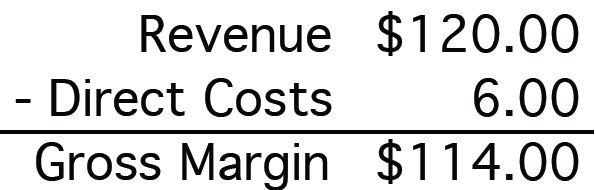
The gross margin for each t-shirt Mr. West sells is $114.00.
So why is it important to track your gross margin?
One important reason is that knowing how much gross margin each unit generates allows you to easily and accurately calculate your break-even unit sales target for a given time period. By dividing your indirect costs by the gross margin generated from each sale, you can estimate how many units you need to sell to break even. Indirect costs, also known as overhead, are all expenses not associated with producing your product or service. Some examples of indirect costs are rent, insurance, electricity, and administrative payroll.
The calculation to do this is: Indirect Costs / Gross Margin = Break-Even Unit Sales
Example: Assuming Mr. West has indirect costs that total $10,000 per month, he would need to sell 87.7 of his t-shirts to break even for the month.
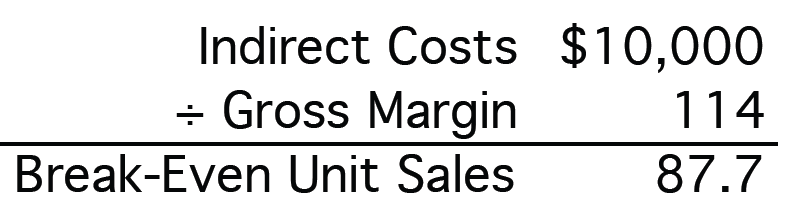
You can see that Mr. West’s strong margins make it easy for him to cover his high overhead.
Another key reason to track your margins is so that you can evaluate the strength of your margins against others in your industry. A simple google search of “gross margin averages for (insert industry name here)” will give you a good starting point for establishing benchmarks to compare against. If your gross margins fall below your industry average, consider increasing the price of your product and/or figuring out how to lower your costs. This will strengthen your margins, and require you to sell fewer units to make a profit.
To illustrate the difference strong margins can make, see the contrasting example below.
Example: Mr. North is not the greatest artist of our generation and he sells his t-shirts for $20. His direct costs are also $6.00 per unit. His gross margin is only $14 per unit, rather than the $114 Mr. West generates. Mr. North would need to sell over 714 units to break even, whereas Mr. West only needs to sell about 88; that’s about 8x the number of units!
So what should you do next?
Break out your financials, calculate your gross margins and units required to break even. Then compare those figures to your industry averages. If you need to strengthen your margins, go back to the drawing board. Reconsider your price; is it too low? Leave no stone unturned when looking for direct cost savings. As you can see, every penny of margin matters.
Have questions? Leave them in the comments!